
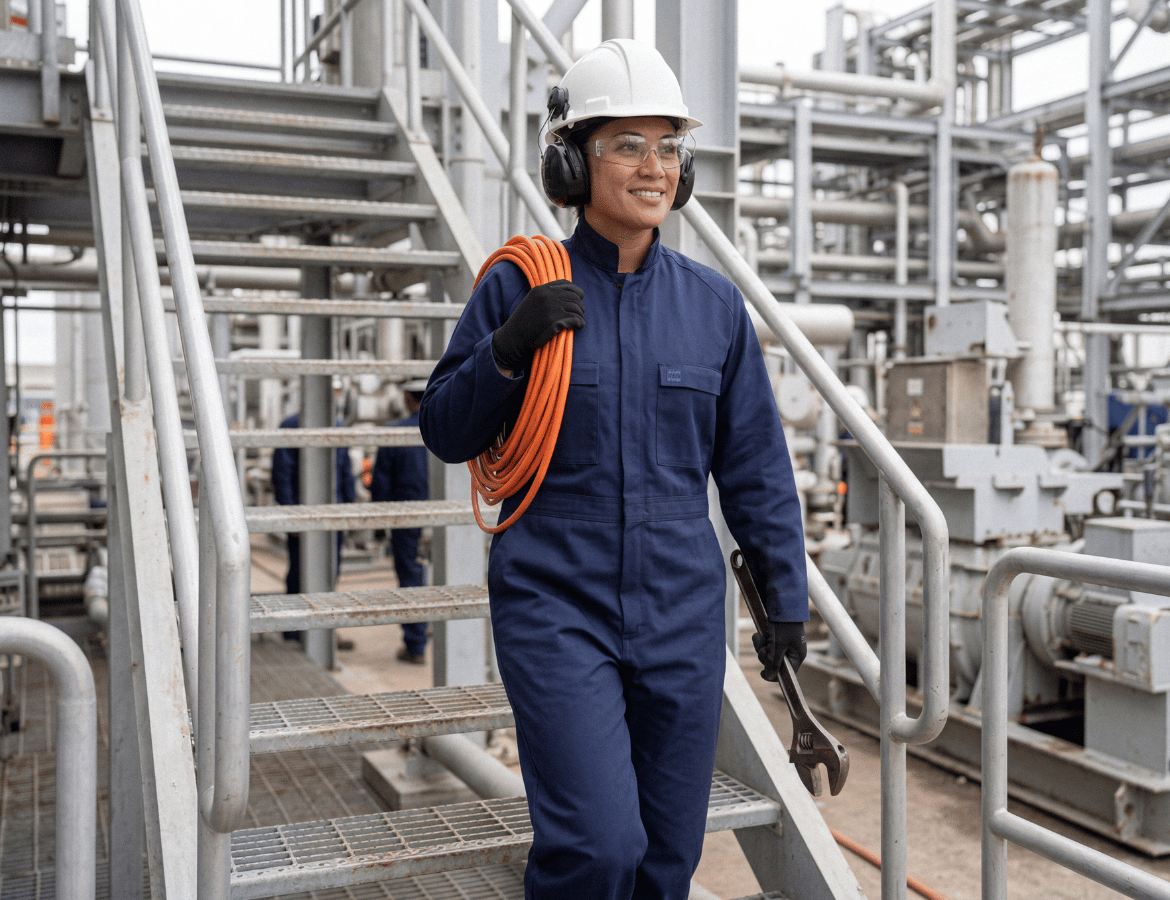
In many industrial workplaces, uniforms are often seen as a basic requirement, something that identifies workers, meets company standards, and provides general protection.
But in high-risk environments, standard workwear simply isn’t enough.
Where exposure to heat, flame or electrical hazards is part of the job, the wrong clothing can do more harm than good. Importantly, the difference between standard garments and flame-resistant (FR) workwear isn’t just technical, it can be critical to worker safety.
The Hidden Risk in Everyday Tasks
Industries such as mining, manufacturing, utilities and infrastructure involve tasks where exposure to hazards like:
- Electric arc flash
- Flash fire
- Welding sparks and hot work
- Molten metal splash
is a real and ongoing risk.
Importantly, even routine work such as electrical maintenance, fabrication, or equipment servicing can quickly become dangerous if a fault occurs or conditions change.
In these environments, clothing isn’t just a uniform. It becomes part of a worker’s personal protective system.
Why Standard Workwear Falls Short
Traditional cotton or polycotton garments are not designed to protect against high heat or flame exposure.
In fact, under certain conditions, non-FR clothing can:
- Ignite when exposed to flame
- Continue burning even after the ignition source is removed
- Melt or stick to the skin, increasing injury severity
This means that relying on standard workwear in high-risk environments introduces a level of vulnerability that many businesses underestimate.
What Makes FR Workwear Different?
Fire-Retardant (FR) workwear is specifically engineered to respond differently when exposed to heat and flame.
Instead of igniting and sustaining combustion, FR garments are designed to:
- Self-extinguish when the ignition source is removed
- Reduce the transfer of heat to the skin
- Provide a protective barrier in arc flash or flash fire events
This behaviour helps reduce the severity of burns and gives workers critical seconds to react or escape.
Futhermore, for environments where arc flash or heat exposure is a foreseeable risk, purpose-built garments such as Arc 2 rated FR workwear provide a defined level of protection suited to tasks like electrical maintenance, welding and industrial operations.
Safety Isn’t Just About the Garment
Choosing the right workwear is only part of the equation.
To perform as intended, FR garments must also be:
- Maintained correctly
- Repaired using appropriate methods
- Laundered in a way that preserves their protective properties
Without the right processes in place, even compliant garments can lose effectiveness over time.
In practice, this is where many businesses face a gap, not in intention, but in execution.
A Smarter Approach to Risk Management
As workplace safety expectations continue to evolve, more organisations are rethinking how they manage protective clothing.
Increasingly, rather than treating workwear as a purchase, they are shifting toward a managed uniform solution, one that supports:
- A more consistent approach to managing protective workwear across teams
- Professional laundering and maintenance
- Ongoing garment replacement as items wear out
This approach helps ensure that safety isn’t just specified it’s sustained.
Moving from Uniforms to Protection
The reality is simple: when heat, flame or electrical hazards are present, standard workwear is not designed for the job.
Recognising this is the first step toward reducing risk and protecting your workforce.
The next step is understanding what level of protection is required, and how to implement it effectively across your organisation.
Speak to our team about compliant FR solutions
Next: In our next article, we break down what Arc-rated workwear actually means — and how to determine the right level of protection for your team.
Disclaimer:
This article is intended as general information only and does not replace site-specific risk assessments or professional safety advice. Fire-Retardant garments are designed to reduce the risk and severity of burn injury but do not eliminate exposure to hazards. FR workwear should always be used in conjunction with appropriate PPE and safety controls. Suitability will depend on your specific workplace conditions.